
.svg)
Statrys vs Airwallex vs Aspire: Best Hong Kong EMI for International Business 2026
- CategoryBanking & FinTech
- DateMarch 6, 2026
- Share



Hong Kong remains a critical global hub for international business, yet traditional bank accounts have become hard to open for cross‑border structures. Increased regulatory scrutiny on AML/KYC, beneficial ownership, and transaction monitoring has tightened access even for legitimate founders.
Electronic Money Institutions (EMIs) emerged to bridge this gap, offering multi‑currency accounts, digital wallets, payment rails, and international transfers without the friction of traditional banks. In 2026, not all EMIs are equal. Statrys, Airwallex, and Aspire each target slightly different needs for internationally mobile founders, and understanding their strengths and limitations is essential before you commit your corporate finances.
Statrys: Straightforward Multi‑Currency Banking with Predictable Costs
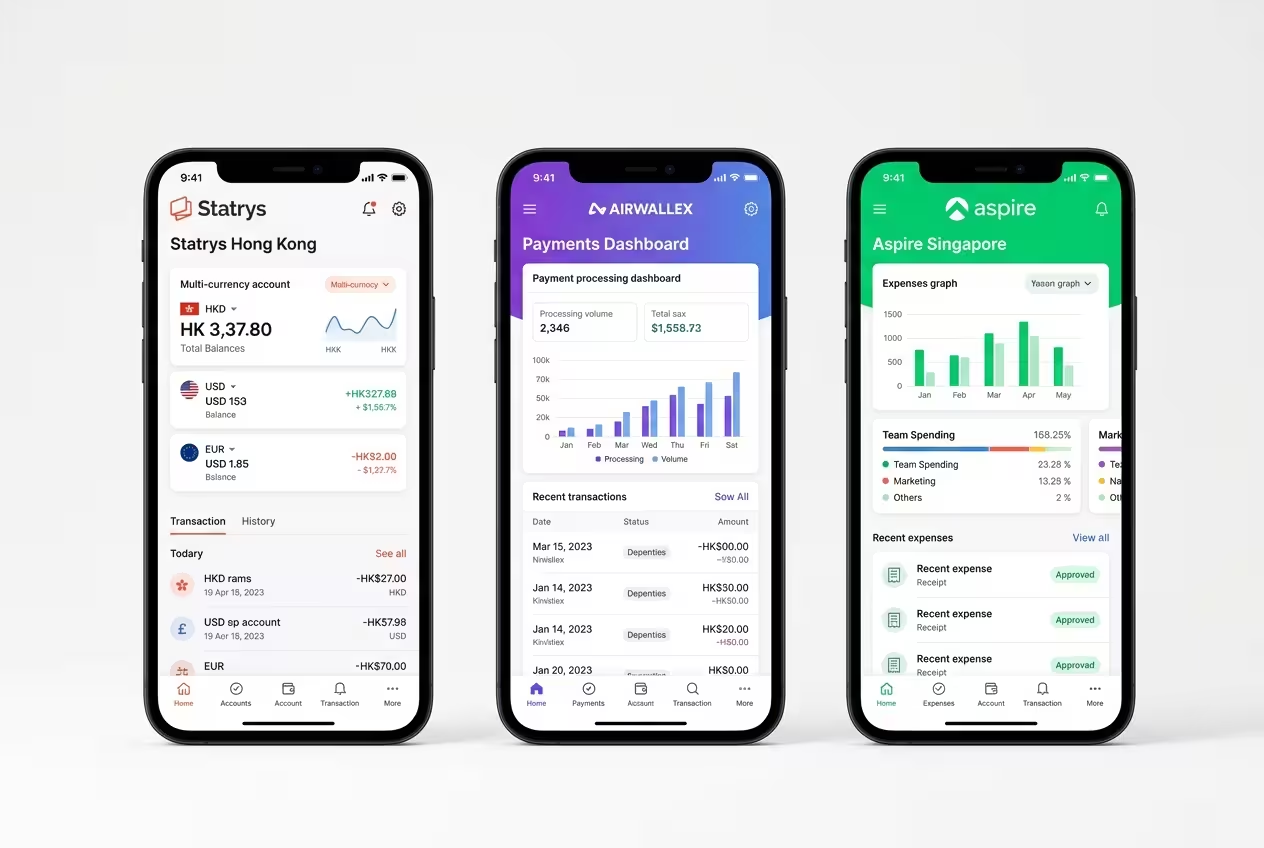
Statrys positions itself as a transparent, business‑friendly financial account focused on international payments and currency management. For many founders, Statrys represents the most approachable entry point for handling international transactions.
Opening an account with Statrys is designed to be frictionless for international businesses registered in Hong Kong, Singapore, the British Virgin Islands, and other common jurisdictions. The onboarding process typically happens online, and Statrys supports major currencies such as Hong Kong dollars, US dollars, euros, British pounds, giving founders flexibility to receive and send funds across regions.
In 2026 Statrys emphasizes predictable pricing: transfer fees are generally flat rather than percentage‑based, and foreign exchange conversions are tied closely to competitive mid‑market rates. This makes budgeting and forecasting simpler for founders who move capital frequently between markets.
What many business owners appreciate is Statrys’s human‑centered support. When complex compliance questions arise, access to real people who understand international structures can make a material difference in approval timelines and ongoing operations.
Statrys may not have every advanced API feature seen on larger platforms, but for many international founders the simplicity of its multi‑currency accounts and clear cost structure are exactly what they need.
Airwallex: Built for Scale and Complex Workflows
Airwallex has positioned itself as a full‑stack global financial platform, particularly appealing for founders whose businesses are scaling across multiple markets.
Unlike some EMIs that focus mainly on banking and transfers, Airwallex combines multi‑currency accounts with extensive integrations, developer APIs, treasury services, corporate and employee cards, and even embedded payment gateways.
For businesses with complex payment needs, such as recurring global payouts, marketplace revenue, or integrated fintech solutions, Airwallex’s ecosystem enables much deeper integration with internal systems. Corporate finance teams can automate foreign exchange, reconcile accounts programmatically, and embed global payment functionality directly into enterprise workflows.
In 2026 Airwallex supports a broader range of payout corridors and more sophisticated treasury management features than most Hong Kong EMIs. That makes it attractive for companies with real operational scale in multiple regions.
However, founders should be aware that Airwallex’s fee structure can include percentage‑based fees on some incoming payments and SWIFT transfers, which may add up for high‑volume operations if not optimized carefully. In addition, while onboarding is designed to be straightforward, support responsiveness can vary, particularly for complex multi‑jurisdictional tax and compliance questions. This contrasts with providers that assign dedicated relationship managers for individual accounts.
For rapidly growing businesses that need integration with payment rails and strong automation capabilities, Airwallex often becomes the default choice, particularly if you anticipate scaling into Asia‑Pacific, Europe, and beyond.
Aspire: Simple, Usable, and Operationally Focused
Aspire enters the comparison from a slightly different angle: ease of use and expense management. It provides multi‑currency business accounts with integrated tools for everyday operations, including virtual and physical corporate cards that sync transactions in real time.
Where Aspire distinguishes itself is in usability. Many founders who juggle ecommerce revenue, SaaS subscription collections, or international contractor payments appreciate Aspire’s intuitive dashboard, clean mobile app, and tools that help with bookkeeping, expense categorization, and reconciliation.
Aspire’s expanded global payment network in 2026 allows low‑cost transfers in dozens of currencies. Many clients also benefit from cashback incentives on business spend, particularly on digital services and software, which can reduce operational costs over time
That said, international transfer speeds and delivery times can sometimes vary, and businesses that require the absolute predictability or priority handling seen at larger platforms may find Aspire’s performance mixed depending on the payout corridor.
Aspire’s support model tends to be digital‑first, with strong self‑service resources and chat assistance, but less emphasis on dedicated account managers. For founders who want operational simplicity and strong integration with day‑to‑day expense workflows, this can be a boon. For those with complex global compliance needs, it may feel less hands‑on than competitors.
Comparing the Three in 2026
All three EMIs are capable solutions, but they suit different business types and strategic goals:
- Statrys is ideal for founders who want transparent pricing, straightforward multi‑currency transactions, and human‑oriented support without a heavy technical lift.
- Airwallex excels for businesses that need deep integration, automation, and treasury features that tie into global ERP systems and custom workflows.
- Aspire appeals to operationally focused companies that want seamless expense management, corporate cards, and low‑friction international payments with a strong UX.
In 2026, regulatory expectations across Hong Kong and Asia‑Pacific have tightened, meaning account approvals require stronger documentation and clearer proof of economic substance. Those institutions that combine compliance readiness with thoughtful onboarding will consistently outperform competitors in terms of approval and ongoing service reliability.
What Founders Should Consider Before Applying
Before choosing any EMI, founders should evaluate:
- The jurisdictions where the company is incorporated
- Whether the board’s decision‑making and substance are documented
- The expected volume and types of international transfers
- Whether API integration will be needed for automation
- Banking needs beyond payments (cards, treasury, liquidity)
Often the best approach is a hybrid one: using one EMI for everyday operations and a second solution for scale or specialized workflows. For example, small international companies may start with Statrys or Aspire for banking and cards, then integrate Airwallex once payment complexity increases.
Looking Ahead
Hong Kong’s role as a fintech gateway continues to evolve. EMIs in 2026 are not just alternatives to banks, for many founders they are central business infrastructure. Choosing the right partner is no longer a matter of lowest fees, but strategic alignment with your corporate structure, compliance model, and growth trajectory.
That means understanding not just what a platform offers today, but how it fits your plan for tomorrow.
At a minimum, every founder should treat fintech banking as part of their multi‑jurisdiction strategy, not an afterthought.
Few things affect day‑to‑day operations more directly than where you hold accounts, how you move money, and how prepared your documentation is for compliance scrutiny.
Where You Go From Here
If you’re evaluating EMIs for your international structure, it’s worth considering your long‑term direction, not just your immediate transactions.
Do you expect rapid expansion into multiple markets? Do you need API‑driven workflows and treasury capabilities? Do corporate cards and expense management matter to your operations? Are compliance and documentation readiness a priority?
Your answers to these questions determine which partner will serve you best.
Evaluating providers without this strategic context often leads to friction during onboarding and frustration in operations.
If you’d like a tailored assessment of how Statrys, Airwallex, or Aspire would work with your specific corporate structure and growth plan, we can map that out with you. It’s often the difference between “okay” banking and banking that genuinely supports your business ambitions in 2026 and beyond.